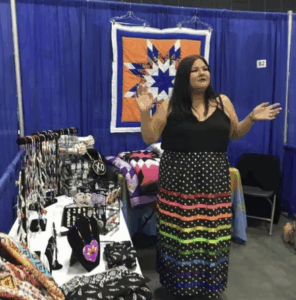
Kayla Morin
Kayla Morin is a third-generation student at the University of Alberta, Aboriginal Teacher Education program. Like many students this past year, Pimohteh Okisikow Iskwew (Woman who walks with the angels) has felt unbalanced in life due to the challenges brought on by the pandemic. She’s working to obtain her bachelor’s in education and join the long line of educators in her family. She hopes to be able to return to her community as a teacher and use her education to help the next generation, just like those in her family have. Kayla dreams do not stop there, she plans to pursue a master’s and a Doctorate.
Kayla has a strong relationship with culture and community and is a proud, engaged community member of the Enoch Cree Nation. She enjoys helping and participating within her community through cultural camps, cooking at feasts, and spending quality time with the Elders in her community. She credits her education for helping her learn new ways to weave Indigenous ways of doing and knowing into her future lessons and her family for showing a healthy life pathway, and giving her the strength, dedication, and resiliency to succeed.
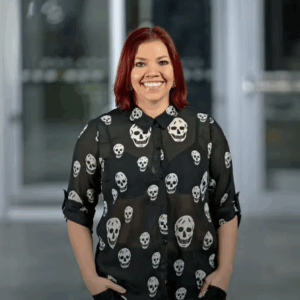
Krista Collier-Jarvis
Krista Collier-Jarvis is a proud Mi’kmaw pursuing a PhD in English at Dalhousie University. With the help of the FG Foundation, she has been able to focus on her research and goals of integrating Indigenous ways of knowing, bring her research into the classroom, share at conferences, contribute to academic journals, and mentor other students.
Krista’s academic career has given her the opportunity to engage in Talking Circles, join discussions surrounding decolonizing museum spaces, bring her recent research on Netukulimk and Etuaptmumk into the classrooms, work on collaborative research on Indigenous Métissage, and write for the Dalhousie University blog, OpenThink about the unmarked grave sites at residential schools on Turtle Island. Krista’s research builds upon her American gothic work and New Wave Indigenous culture that provides an interdisciplinary approach to Indigenous Gothic film and literature. She has also published writings on contagion and Indigenous survival stories. You can read Krista’s published OpenThink articles here.
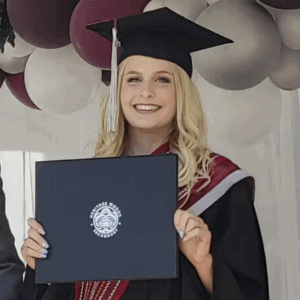
Elisa Pasceri
When Elisa graduated from high school, the COVID-19 pandemic was at its’ peak. Like many others her age, her senior year changed from going to school every day, seeing friends, playing hockey and softball, and just being a teenager to zoom classrooms, social distancing, no sports, and a graduation like no other.
The pandemic left Elisa nervous and stressed about the future path into post-secondary education. Feeling lost and unsure she reached out to the Métis Nation of BC, and they helped her enroll in the Office Assistant Certificate at Okanagan College. This one-year program seemed to be the right step for Elisa to gain an introduction to ‘college life’ and develop core skills for any career. Elisa has gained confidence and is using her new skills and experiences as an Office Assistant and aims to start her own small business. Support from the FG Foundation helped provide Elisa the opportunity to focus more on her studies and less about financial stress.
Amanda Sault
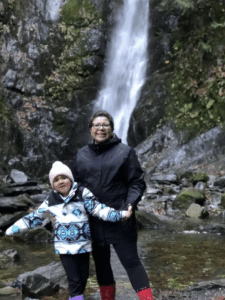
Amanda is extremely grateful to be an FG Foundation scholarship recipient. She is enrolled in her 2nd year of 4-year Juris Doctorate, Joint Degree in Canadian Common Law and Indigenous Legal Orders, at the University of Victoria. Amanda aspires to work for our Nations and create change to build a better future for all Indigenous peoples and communities so adversely impacted by laws and policies that are not our own. Amanda says, “I feel that in order to progress as a people we need to be able to understand the language of the law and make it applicable to our Indigenous Laws”.
With support from the FG Foundation, Amanda was able to alleviate multiple stresses for her and had the chance to put some extra focus into making sure her family’s needs were met while she was in school.
Justin Langan
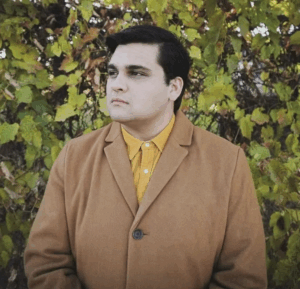
Justin is pursuing his undergraduate degree in the Faculty of Arts at the University of Manitoba studying film and philosophy. He’s a passionate student who aims to use his degree in film to spotlight rural Indigenous communities in Manitoba and help amplify the voices of their community members through documentary or narrative features.
Support from the FG Foundation has helped him with tuition and books and given him the chance to connect with other youth leaders. Justin hopes to use his education to help him advocate for more rights for Indigenous youth across Canada and says, “In these unique and difficult times my heart is full knowing I can pursue my education goals with this kind of support“.
Alejandra Metallic-Janvier
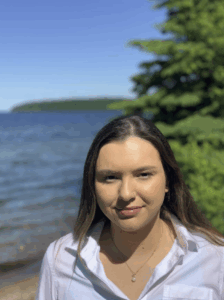
Alejandra is an intergenerational survivor pursuing an Honours Bachelor of Science in Neuroscience and Mental Health from Carleton University. After her first year in her program, she realized how important it was for her to give back to her people and start working in the Mental Health field, particularly with the Indigenous population.
Alejandra is focused on exploring and finding solutions to the impacts of intergenerational trauma caused by colonial violence. Alejandra has seen how the science community lacks a solid understanding of how trauma can be passed down through generations on a biological and psychological level and as a result, acknowledges that there is a lack of concrete solutions and resources for Indigenous peoples who suffer from this trauma. It is her goal to use her education to study intergenerational trauma from a scientific perspective and apply that knowledge to initiate a brighter, positive future for Indigenous peoples in Canada. Alejandra has made the Dean of Science Honours List and been chosen to work on an exceptional research project with Dr. Kim Matheson, Director, and Professor in the Department of Neuroscience at Carleton University. This project will explore how intergenerational exposure to harmful colonial policies have affected Indigenous youth in terms of cultural understanding and pride. Their focus will be on the self-expression of youth through the arts, as a means to reclaim their Indigenous identity and how the youth view this in relation to their mental health.
The funding received from the FG Foundation has helped Alejandra immensely on her education journey and gave her the ability to focus solely on her studies and reaching her goals. The scholarship enabled her to purchase important studying resources that will bring long-term benefits in terms of ease and efficiency in the education process.
Reggie Neeposh
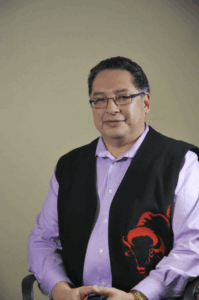
As an Indian Residential School Survivor, Reggie has always had the goal of relearning his traditional Cree way of life and reconnecting to the land his late father once survived on. The FG Foundation helped Reggie return to his home territory and learn traditional land-based skills like hunting, fishing, and trapping.
Through this reconnection, Reggie feels as though he has had an opportunity to ease the pain caused by Indian Residential School and found new strength within himself, as well as a sense of belonging. Reggie still has many skills he would like to learn, and he hopes to one day pass the knowledge he has gained onto his grandchildren and will continue to practice his Cree way of life.
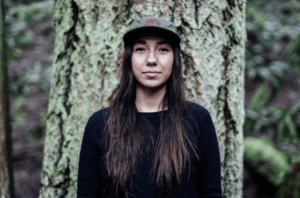
Myia Antone
With support from the FG Foundation, Myia Antone, an intergenerational survivor, was able to attend the Squamish Language Immersion Program from the First Nations Languages Program at Simon Fraser University. Through this program, Myia had the opportunity to learn her traditional language, and explore how her ancestor’s worldviews are embedded into the language and the current world around her.
Myia sits on the Squamish Nation Youth Advisory Council and is confident that learning her language will help her better represent the Squamish youth and gain a better understanding of what it means to be a leader in her community.

Kira Doxtator
Kira studies Social Sciences and Criminology at the University of Toronto and is an intergenerational survivor whose studies surround identifying the systemic flaws in the Canadian Justice System. Her education and background are what has made Kira become passionate about finding solutions to help end the Missing and Murdered Indigenous Women crisis.
While also pursuing her studies at U of T, Kira also set the goal of taking Anishinaabemowin language courses so she can directly contribute to the revitalization of her traditional language. Support provided by the FG Foundation helped Kira be able to pursue her language goals and keep the financial stresses behind her so she could focus on all her courses throughout the semesters.
For Kira, being able to study Criminology and Anishinaabemowin means having the opportunity to ignite change and reach her goal of ending the cycle of violence against Indigenous women and respectfully continuing their legacy.
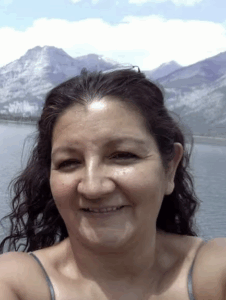
Charlotte Ross
As a young girl, Charlotte loved to learn and made a commitment to herself to keep her language and culture alive while also attaining the highest level of education she could without losing her self-identity. Charlotte is an intergenerational survivor and has completed her PhD in Indigenous Language Revitalization at the University of Victoria.
By listening to family and community members share teachings and speak Cree, Charlotte immersed herself in her culture and language. Through her Indigenous Language Revitalization program, she has been able to learn about the experiences, worldviews, and cultures of other Indigenous groups throughout Turtle Island.
As a mature student, Charlotte would not have been able to complete her studies without the added financial support from the FG Foundation. These funds have helped Charlotte become a proud student and focus on her program rather than finances.
“When we become more aware of the many facets of learning, our Indigenous languages are an endless source of comfort, healing and inspiration. hiy hiy kinanāskomitināwāw”