
Tootinaowaziibeeng Treaty Reserve 292
The Tootinaowaziibeeng Treaty Reserve is an Anishinaabe First Nation nestled in the forests and prairies near Roblin, Manitoba. The community’s total population is just under 1,500, with 670 people living on-reserve.
The small community is close to many idyllic feats of nature, including the Duck Mountain Provincial Forest, making it the perfect place for hikers and those seeking a connection with the land. Over the summer of 2022, the Tootinaowaziibeeng Treaty Reserve hosted a project called the “TTR Youth Training Camp” with the help of funding from the FG Foundation. The project trained 17 youths to become registered hunting and backcountry guides.
Seeing the potential to be stewards of the land and the opportunities it would bring for its young people living in community, the program offered a pathway for youth to build a career in the wilderness industry. The program sought knowledge from Elders and traditional on-the-land teachings to guide the curriculum. Participants were given the opportunity to partake in the Manitoba Hunting Safety Course, wilderness safety, survival training, wildlife awareness, predator safety training, and on-the-land training.
Through fostering a deeper connection between the community’s youth and Elders, and a combination of traditional knowledge and modern safety practices, the TTR Youth Training Camp project opened pathways for youth to achieve their goals and earn their certifications.
Thanks to the program’s teachings, many of the community’s youth can see themselves building a future and a career in Tootinaowaziibeeng, lending their new-found expertise to visitors and future generations for years to come.
To learn more about the TTR Youth Training Camp, visit the website here.
Saskatoon Survivors Circle
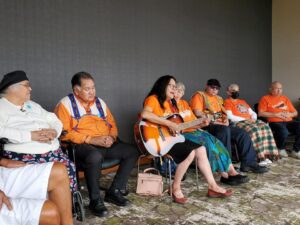
The Saskatoon Survivors Circle (SSC) was founded in 2019 with the principle: “nothing for us, without us” to ensure that, unlike institutions offering similar assistance, the services and activities provided by SSC were not “token or paternalistic.”
They started as a support network for Residential School Survivors in Saskatoon and the surrounding area with four main priorities: Cultural Connectedness, Holistic Wellness, First Nations, Métis, non-Indigenous Inclusion, and Systemic Change. Using the FG Foundation monies which come from the surplus from the IRRS Settlement Agreement, the Survivors have created a safe space to connect with one another, share their experiences, learn, heal, and create a community.
Thanks to their commitment to these principles – and to their community – the SSC has now grown its network of Residential School Survivors to over one hundred members. The Survivors at SSC, who are known to Saskatoon’s Indigenous community as a group of honoured and respected Knowledge Keepers, are often called upon as consultants by educators, advocates, and policymakers throughout the City of Saskatoon. With the continued support of the FG Foundation, and the hard work of volunteers and Survivors, the SSC has forged lasting cultural connections with their network through traditional craft, ceremony and technology and has become an organized, dynamic support group for its members in the City of Saskatoon.
Survivors of Residential Schools have endured devastating mental, physical, and spiritual harms which the SSC aims to address through holistic methods of healing and wellness, engaging in difficult conversations with Knowledge Keepers, and creating a path toward an “Indigenous sense of self.”
One of the many achievements of SSC in 2022 was to incorporate voices from Elders and Survivors into a manual for Indigenous estate planning, called When the Time Comes – A Guide for End-of-Life Planning for Indigenous People.
The SSC intends to continue creating awareness around the legacy of Residential Schools and building opportunities and healing pathways for Survivors and members.
Waseskun Healing Centre
The Waseskun Healing Centre was founded in 1988 near Saint-Alphonse-Rodriguez, QC, with a mission to aid the healing process of incarcerated Indigenous men, while guiding their successful re-entry into their families, communities, and Nations.
The non-profit, Indigenous-led organization collaborates with local First Nations communities and Elders who share their knowledge of tradition, ceremony, and how to live well. Through these and other land-based teachings, residents at Waseskun learn how to accept responsibility for their actions and to understand the consequences they have created for themselves and others.
In the spring of 2021, a grant from the FG Foundation helped Waseskun Healing Centre launch a new program to aid its residents in obtaining long-term employment, formal education, and more.
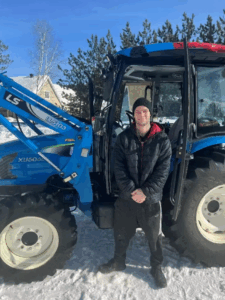
The Barbara Monture Malloch Education Resource Centre (BMMERC) offered residents practical skills courses in safely operating power tools and light construction equipment, as well as preparatory classes for undertaking the standardized high school equivalency test (GED).
The BMMERC also granted residents access to a new library, complete with new computer equipment, which allowed them to improve their literacy skills and technological proficiency. Not only did this empower residents to improve their career prospects for the future, but it also enabled many to embark on personal research projects involving Indigenous language, community, family, tradition, heritage, and reconciliation.
The Waseskun Healing Centre says plans for the BMMERC include negotiations for residents to get hands-on training while working on local construction projects, the development of a carpentry training course, and the implementation of a higher education program for residents.
Mary Duncan School
The Mary Duncan School is located in the small town of The Pas, MB, bordered by the Opaskwayak Cree Nation. The school offers alternative programming, allowing students to complete the regular high school curriculum at a pace that meets their individual needs.
In Sept. 2021, students saw a new addition to the curriculum – the “Reclaiming Indigenous Knowledge in Public Schools” program was implemented with the support by the FG Foundation. The program aimed to bring traditional land-based Northern Cree and Metis teachings to grades 7 through 12.
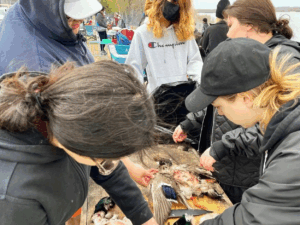
Young people had the opportunity to earn high school credits while learning in First Nations, Metis and Inuit studies. Activities included drumming, beading, and ribbon skirt making workshops, and taking part in other land-based activities.
The land-based activities the students took part in reflected the changing seasons: in the fall, they prepared, canned, and stored food for the winter; in the winter, they learned how to trap animals, snowshoe, and survive in harsh weather conditions.
Students were also taught traditional Northern Cree methods of food preparation, such as how to make pemmican, stews, soups, and Bannock.
Prior to the program’s implementation, many of the students had limited experience to land-based learning. The “Reclaiming Indigenous Knowledge in Public Schools” program gave students at the Mary Duncan School an opportunity to explore their culture, traditions, and a connection to the land. This program has allowed school administrators to experience and share daily smudge ceremonies, a new experience for some students.
If you want to learn more about the Mary Duncan School, follow this link.
The Community of Membertou
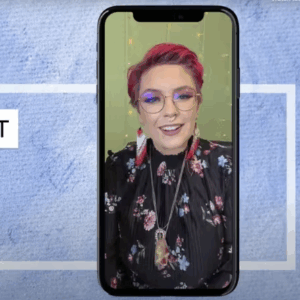
The Community of Membertou and its Elders recognize the importance of sharing culture and history with all people and believe that this sharing and celebration must come from the community itself. With support from the FG Foundation, the Membertou Heritage Park launched the Kun’tewiktuk: A Celebration of Mi’kmaq Art, Music, and Culture program, an arts program that fosters the growth of the next generation of Mi’kmaw artists.
Aspiring young artists received a bursary and were paired with a mentor for periodic one on one training. All participants were nominated through Membertou First Nation, for the six-to-seven-month program. The young artists specialties include photography, beadwork, and painting. The mentors worked with the artists through virtual workshops to introduce viewers to the craft, discuss the cultural & historical significance, and teach key practices & techniques for those interested in pursuing opportunities in each artists’ discipline.
These mentorships provided the young artists a chance to hone their skills, learn from a respected artist, and carve a new path to success. The final stages of the program will see the artists creating and having the chance to showcase their work inside the Membertou Heritage Park, a community space that offers a living history of the people of Membertou. Over the course of the project, Kun’tewktuk has documented the journey of these young artists and share their experiences and artistic creations. View it here. The workshops were recorded and posted online to be shared with viewers across Turtle Island.
Smith’s Landing First Nation
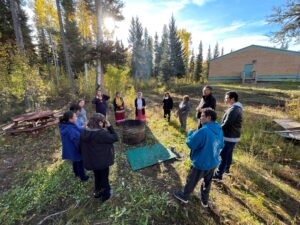
To foster community and personal development, the Journey to my Best Self program focuses on healing and reconciliation for the people in the Akaitcho region, specifically for the Smith’s Landing First Nation, Salt River First Nation, and the Northwest Territories Métis membership.
The program is a culture-based program that created opportunities to heal for personal development. The program hosted a variety of cultural and educational activities with an emphasis on historical policies and interventions that have deeply disrupted the intergenerational exchange of traditional knowledge.
The facilitated workshops focused on helping participants identify personal wellness goals to work towards and created a welcoming place to hold talking circles and discuss the intergenerational residential school traumas that affects their region. Participants taught Dene traditional values, laws, and relationships and learned how to build on them for a positive future. Participants also explored different communication tools, traditional crafting, arts lessons and cultural skills like moose hide tanning, ribbon skirt and shirt making. The group included adults of all ages including Elders and residential school survivors.
The program was created with hopes to help the people to recognize their own value, connect to inner strengths and inner resources within themselves and grow as strong Dene.
Peguis Foundation Inc.
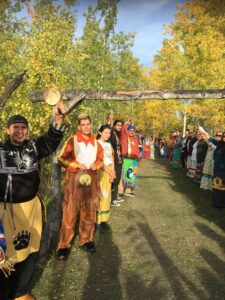
The Peguis Foundation Inc. Spirit and the Land Excursion Camp brought 116 youth out on the land to experience culture, music, arts, and land-based learning through eight different day camps. The planning team was committed to get youth outside and on the land during different seasons, even under the pandemic conditions. Each camp day started with a ceremony lead by community Elders and each had a different focus.
The many camps focused on several themes: Elder care and how youth can be more helpful and supportive to our community elders; camps on traditional craft making skills of ribbon skirts, shirts, shields, moccasins and drum making; on the land medicine picking, medicine pouches and teachings; the sweat lodge camp included the material gathering of wood and rocks; the land based skills of fishing and lunch preparation on the local beaver pond.
These camps brought Elders and Youth together and each day’s activities brought excitement and positive learning experience. The program helped bring youth together and helped strengthen family connections through cultural programming and teachings.
Kenhtè:ke Seed Sanctuary & Learning Centre
“By planting seeds in our own lands, we reinforce our connection to the land and the Seeds”.
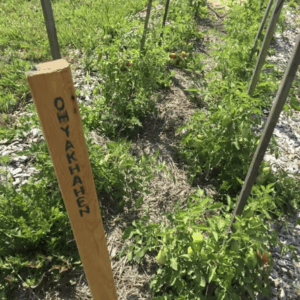
The Kenhtè:ke Seed Sanctuary & Learning Centre (KSSLC), located in Tyendinaga is home to a 40-year-old living collection of almost 300 seed varieties. The support of the FG Foundation has allowed Kenhtè:ke Seed Sanctuary to share this knowledge of food and seed sovereignty with the next generations and previous ones’ too. The gardener on-site at the KSSLC is teaching youth assistants and volunteers how to maintain the seed collection, the practice of seed saving, sorting, packaging, labelling, storage, best practices, traditional gardening techniques, what it means to grow on a rotating schedule, and sharing seeds within the collective. The lessons shared while out on the land.
This project is an ongoing cultural revitalization process for the community. The KSSLC has created an environment where community members can learn traditional Rotinonhsyón:ni cosmology, practices, protocols, and languages. Different lessons on the importance of seeds and how they are incorporated into the Creation Story of Rotinonhsyón:ni people and how they are critical to the continuance of the Onkwehonwe connection to Tyonnhéhkwen – our life sustainers. The KSSLC sharing has fostered youth learning, volunteerism, continues to connect local schools and senior groups, and provides a pathway for knowledge sharing for future generations. The outreach and training efforts that have been accomplished with the project have impacted Tyendinaga especially, and even reached other Mohawk communities like Kanehsatà:ke with online seed saving events.
Mosquito Grizzly Bears Head Lean Man First Nation
Healing, Empowerment, Education and Employment Project
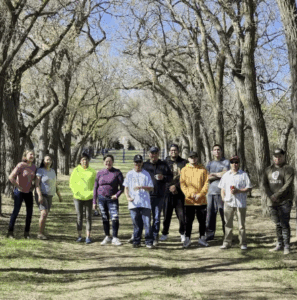
Mosquito Grizzly Bears Head Lean Man (MGBHLM) First Nation is an Assiniboine Nation located in the Eagle Hills of Saskatchewan with just over 1000 members. The HEEEP program was designed to support unemployed youth and adults who are struggling with the intergenerational impact of Residential Schools, leaving too many in a despair state. Support from the FG Foundation and MGBHLM Economic Development helped the community empower unemployed community members to make positive changes in their lives, family lives and great community lives.
The intensive 6-month holistic healing program provided participants with the chance to attend healing circles, feasts, and MGBHLM history lessons including the history of the signatory in Treaty 4 & 6, and language teachings hosted by an Elder and employment training services. The participants gained one week training for safety tickets, life skills training which included a 1-week practicum within a business owned by MGBHLM Economic Development. These program offerings created a sense of belonging, connection to culture, positive experiences, and sense of pride in their history and strength in knowing of the Warriors who came before.
Throughout the duration of the program, participants focused on the personal holistic development and importance of family values and connection. The healthy environment generated will support the community to move forward, explore new ways of being and hopefully help set participant on a future path of success.
Manitoba Indigenous Cultural Education Centre Inc.
The Manitoba Indigenous Cultural Education Centre (MICEC) was founded to address the devastating effects of Canada’s assimilation policy towards First Nations people and proactively works to support First Nations people reclaim their cultures, languages, and education in Manitoba. With the support of FG Foundation, the MICEC hired an online learning coordinator and created 18 different videos to educate and share Indigenous cultures and languages in Manitoba. The MICEC selected educational topics of parenting, crafting, language, harvesting, storytelling, history, and treaties to share with their audiences and throughout the duration of the project they had a over 10,000 viewers including 150 residential school survivors.
MICEC Online highlighted and provided a platform for individuals to share their knowledge, talents, skills, and stories with viewers and connect them with the people, communities and organizations who are revitalizing Indigenous languages and cultures. By creating videos and online content it allowed a larger community to connect with knowledge keepers, activists, and leaders to find wellness in this time.
Interested in learning how to peyote stitch or sew your own ribbon shirt? Click here. Or you can explore videos on parenting, language, harvestings, storytelling, history, and treaties from MICEC online here.